
Custom Manga Printing Service — Tankōbon B6 & RTL
Bring your manga to life with original manga trim sizes or traditional localized trim sizes, fantastic halftone reproduction, and traditional Kuchi-e color inserts. Whether you are printing your first indie single-issue or you are a corporate localization company bringing translated Japanese series to North American retail shelves, our commercial presses ensure your screentones are crisp and your volumes are bookstore-ready.
Popular Manga Sizing & Pricing
Instant pricing for traditional volume runs. ‡
Tankōbon (JIS B6)
Authentic, premium manga volume sizing identical to physical Japanese retail releases. Optimal for traditional halftone scaling, minimizing moiré patterns on uncoated papers. *
Digest (5.5" x 8.5")
Standard Western localized manga sizing similar to high-volume US retail titles. Provides larger canvases for panel clarity while remaining perfectly economical to mass produce in the US. †
* Standard JIS B6 Tankōbon size, 150 pages. Printed b/w on textured 60# Uncoated Text interior stock with full-color 100# Silk Cover (C1S). Perfect Bound.
† Western Digest Size (5.5" x 8.5"), 150 pages. Printed b/w on textured 60# Uncoated Text interior stock with full-color 100# Silk Cover (C1S). Perfect Bound.
‡ Prices shown are base estimates and do not include applicable taxes or calculated shipping.
Mangaka Reviews & Print Quality
See what comic artists and manga publishers say about our books.
eriochromaticVerified Buyer
Ordered: Size: 5.827" x 8.268", Binding: Perfect Bound, Interior Paper: 100# Silk Text - Color (42 pgs), Cover: 111# Silk Cover (C1S) - Color
My new go-to company for any artbook printing!!! This was my first time printing an artbook, and MCE was extremely helpful and patient with me in terms of choosing paper types and answering any production questions I had. They also provided me with different versions of one of my darker pages during the proofing phase so that I wouldn't have to worry about how the colors would turn out for the final! Everything went super smoothly and I couldn't be happier. (the rounded corners in the interior photos were cut by me, since it was a decision I made after I received the books. In the future, I'd love to have an option like that during the production phase!)
PuddingVerified Buyer
Ordered: Size: 7.165" x 10.118", Binding: Perfect Bound, 36 BW pgs + Cover, Lamination: Gloss
Great quality for the price for a US-based printer! Extremely fast service as well! I'm very happy with the outcome of this project.
Perfect Screentones
Manga relies on delicate screentones and precise shading. Our advanced RIP servers use specialized halftone screening to prevent moiré patterns, ensuring your black-and-white tones print exactly as you drew them.
Authentic Manga Trims
Whether you want traditional Japanese JIS B6 or standard US digest sizes, we provide exact templates and perfectly cut trims. Your volumes will feel indistinguishable from established tankōbon found in retail bookstores.
Mixed Media & Kuchi-e
Why pay full color for an entire book just to have a few color inserts? We allow you to seamlessly mix vibrant Kuchi-e color inserts with incredibly crisp black and white interior pages, drastically reducing your costs.
Artist Alley to Retail
From printing 20 copies to test out a new series at a local anime convention, to scaling up to 2,000 copies for a massive commercial launch, our scalable domestic presses handle all volume with unmatched quality control.
Traditional Manga & Light Novels
Specialty trims and perfect bindings designed for standard manga volumes.
Also see our dedicated Light Novel printing service → • Manga Dimensions & Paper Guide →
Manga
We specialize in printing manga the way it was meant to be read. Choose from standard trade sizes, authentic uncoated paper stocks, and even right-to-...
Light Novels
Bring your original stories to life with industry-standard formatting. We pair crisp text printing with authentic, comfortable-to-read paper stocks to...
Authentic Japanese Trim Sizes: JIS B5 vs ISO B5 vs A5 vs JIS B6
Manga formatting requires uncompromising precision. Japanese Industrial Standard (JIS) sizes differ substantially from international ISO standards and Western paper sizes. Printing with authentic dimensions prevents panel distortion, cut-off furigana, and screentone moiré.
Manga Trim Size, Bleed & Pixel Matrix
Exact dimensions at 0.125" (3.18 mm) bleed, 300 DPI (color), and 600 DPI (halftone monochrome).
| Format Name | Finished Trim | Canvas (+0.125" Bleed) | 300 DPI Canvas | 600 DPI Canvas | Safe Zone Margins | Primary Use Case |
|---|---|---|---|---|---|---|
| JIS B5Doujinshi / Magazine | 7.17" × 10.12" 182 × 257 mm | 7.42" × 10.37" 188.4 × 263.4 mm | 2226 × 3111 px | 4452 × 6222 px | Outer: 0.25" / Gutter: 0.375" | Tokyo Comiket doujinshi, oversized anthologies, deluxe artbooks |
| ISO B5International Zine | 6.93" × 9.84" 176 × 250 mm | 7.18" × 10.09" 182.4 × 256.4 mm | 2154 × 3027 px | 4308 × 6054 px | Outer: 0.25" / Gutter: 0.375" | European art booklets, localized comic zines, illustration portfolios |
| A5Kanzenban / Seinen | 5.83" × 8.27" 148 × 210 mm | 6.08" × 8.52" 154.4 × 216.4 mm | 1824 × 2556 px | 3648 × 5112 px | Outer: 0.25" / Gutter: 0.375" | Wide-ban collector manga, graphic memoirs, literary seinen editions |
| JIS B6Tankōbon Standard | 5.04" × 7.17" 128 × 182 mm | 5.29" × 7.42" 134.4 × 188.4 mm | 1587 × 2226 px | 3174 × 4452 px | Outer: 0.25" / Gutter: 0.375" | Authentic Japanese commercial retail manga (Shonen Jump, Kodansha) |
| US Manga5.0" × 7.5" Standard | 5.00" × 7.50" 127 × 190.5 mm | 5.25" × 7.75" 133.4 × 196.9 mm | 1575 × 2325 px | 3150 × 4650 px | Outer: 0.25" / Gutter: 0.375" | North American English localized releases & indie graphic novels |
Screentone Moiré Prevention (600 DPI Rule)
In manga production, moiré is an optical wave interference caused when repetitive digital dot screens clash with a digital press's RIP output grid. Avoid these three common pitfalls:
- ✓Draw & Export at 600 DPI: Keep black-and-white comic lineart and tones at 600 DPI monochrome. This ensures dots remain pure binary pixels (100% Black / 0% White) without anti-aliasing blur.
- ✓Respect Line Screen Frequency (LPI): Standard manga tones should stay between 50 and 65 LPI. Higher frequencies (70+ LPI) trigger dot gain plugging on uncoated paper.
- ×Never Scale Toned Images: Resizing a pre-rasterized 60LPI screentone destroys its dot pitch, producing visible zebra banding or moiré rosettes. Always tone at 100% output scale.
Right-to-Left (RTL) Gutter Safety
When printing traditional right-to-left (RTL) Japanese manga, the binding spine is on the right side of the book when looking at the front cover. This shifts gutter margin physics:

Pro TipBook Spine Calculator
Don't guess your spine dimensions. Use exact paper caliper measurements to output precise templates for perfect-bound manga covers.
Calculate Spine WidthToolImage DPI
Checker
Ensure your screentones are crisp. Upload your interior pages to guarantee they meet the 300 DPI commercial print threshold.
Check Your DPIToolTemplate Generator
Start with the correct canvas size. Download exact bleed and safe-zone margins tailored for MCE Printing trims.
Generate TemplateToolQR Code
Generator
Create print-ready vector QR codes linking back to your Linktree, Patreon, or storefront online.
Create QR CodeManga Printing FAQs
Common questions from independent creators.
What are the standard sizes for manga printing?
Most traditional Japanese manga volumes are printed in JIS B6 or ISO/JIS A5. We fully support these authentic Japanese trim sizes along with JIS B5, ISO/JIS A4, and traditional US sizes (like 5x8 or 5.5x8.5). We provide templates specifically for proper manga dimensions.
How do I ensure my manga halftones print clearly without moire patterns?
For the best manga printing results, we recommend submitting your black and white interior files at a minimum of 300 DPI. Our commercial RIP servers utilize advanced halftone screening to prevent moire patterns.
Can I print a right-to-left reading manga?
Absolutely. We specialize in right-to-left bindings. You can set up your project to be right to left in our building tool.
What is the best binding for a manga?
We highly recommend Perfect Binding for manga volumes. This provides a professional, flat, square spine that can accommodate hundreds of pages, exactly like the volumes you'd find in a bookstore.
Do you support mixed media printing (color inserts with B&W pages)?
Yes! We are one of the only printers in North America that fully supports mixed media printing for manga, including traditional Kuchi-e (口絵) color inserts. Instead of charging you full color pricing for the entire book, we can build a custom quote with separate, accurate pricing for your specific color pages and black & white pages.
What is the difference between printing a manga and a comic book?
Western comic books are typically printed on glossy, coated paper in full color and saddle-stitched (stapled). Traditional Japanese manga are printed in black-and-white on uncoated, textured paper with a perfect bound square spine. We support both, and our manga printing process offers authentic japanese tankōbon (単行本) aesthetic or any of your preferred manga sizes.
How do you handle manga screentones and shading?
It is all about file preparation! You simply need to make sure your files are at least 300 DPI, and our professional presses and processing servers will handle the rest to ensure your shading prints perfectly.
Can I print a small run of manga for an anime convention?
Yes, we specialize in convention printing for indie manga artists. We offer zero minimum order quantities. You can print 10 copies for an Artist Alley table, or 1,000+ copies for a major Kickstarter launch, all with incredibly fast turnaround times.
Do you print for English manga localization companies?
Absolutely. We are a premier commercial print partner for North American manga localization companies translating Japanese originals. We offer enterprise-grade B2B print volume discounts, rigorous quality assurance for halftones, and direct shipping logistics for commercial retail publishers.
What is the difference between a Kuchi-e and a frontispiece?
While a frontispiece is a general Western publishing term for any illustration facing a title page, a Kuchi-e (口絵) is a historically Japanese formatting standard. In modern manga and light novels, Kuchi-e refers specifically to the high-quality, full-color inserts placed at the very beginning of the volume, printed on distinctly different glossy or silk paper compared to the uncoated black-and-white interior pages.
What is the exact physical difference between JIS B5, ISO B5, A5, and JIS B6?
JIS (Japanese Industrial Standard) trim sizes differ from international ISO standards. JIS B5 is 182 x 257 mm (7.17" x 10.12"), which is the iconic Comiket doujinshi standard. ISO B5 is smaller at 176 x 250 mm (6.93" x 9.84"). A5 is 148 x 210 mm (5.83" x 8.27"), used for wide-ban and Kanzenban collector editions. JIS B6 is 128 x 182 mm (5.04" x 7.17"), the universal Japanese retail Tankōbon volume standard. MCE Printing cuts to true JIS millimeter specifications on computerized guillotine cutters.
Why should black-and-white manga screentones be drawn at 600 DPI rather than 300 DPI?
At 300 DPI, fine screentone dots become anti-aliased with semi-transparent gray edge pixels that clash with digital press RIP screening frequencies, creating ugly wavy moiré patterns. At 600 DPI (or 1200 DPI 1-bit monochrome), dots render as razor-sharp binary marks that transfer cleanly to paper without interference. Furthermore, always maintain screentone frequency between 50 and 65 LPI, and never resize artwork after screentones are applied.
How much inner gutter margin is required for perfect-bound right-to-left manga?
Because perfect-bound manga books have a squared glue spine, the inner binding edge loses approximately 0.125" to 0.25" of visible area in the book curve. We recommend maintaining an inside gutter safe margin of 0.375" to 0.5" (9.5 to 12.7 mm) along the right side of odd pages and the left side of even pages for right-to-left (RTL) manga, ensuring no dialogue or facial details are swallowed into the spine.
Short-Run Doujinshi
Interested in smaller saddle-stitch books or independent zines?
View our specialized Doujinshi printing landing page →
Doujinshi (Saddle Stitch)
Bring your fan works and original comics to life with our premium Doujin printing service. We offer Traditional JIS B5 or A5 Doujin dimensions, and mo...
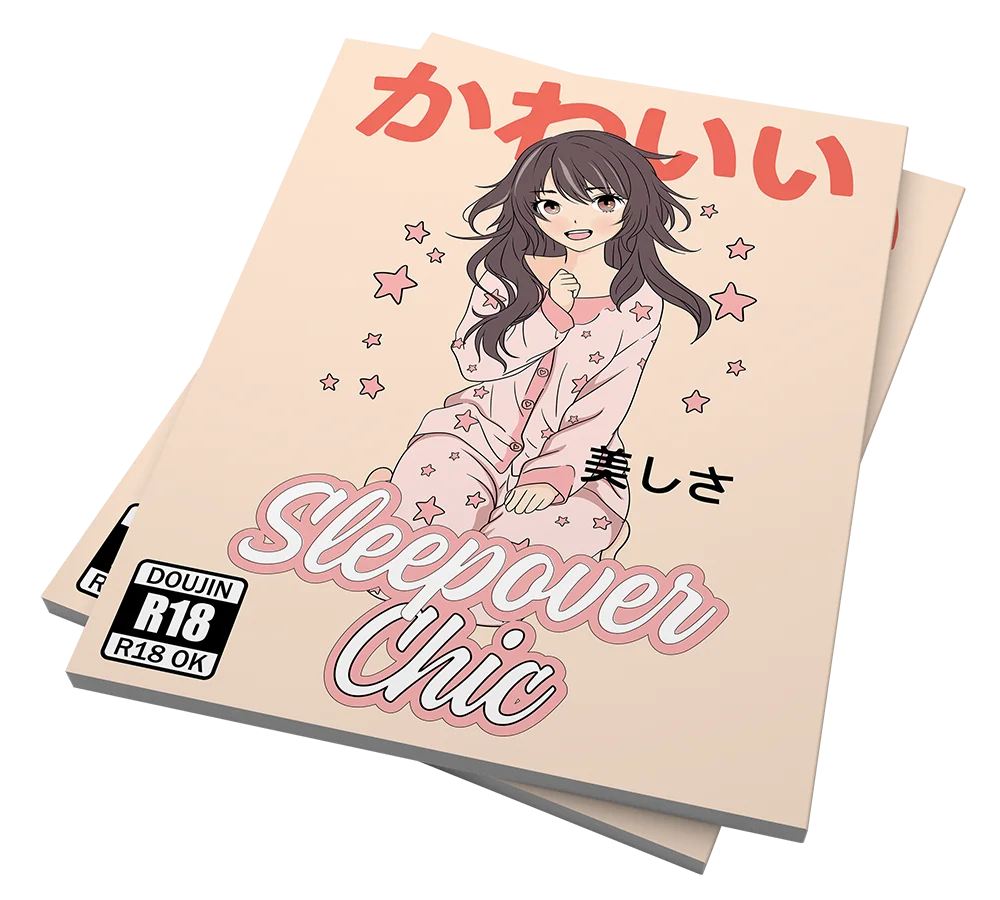
Doujinshi (Perfect Bound)
Give your larger collections and anthologies a professional finish with our perfect binding service. This option creates a durable, square printable s...